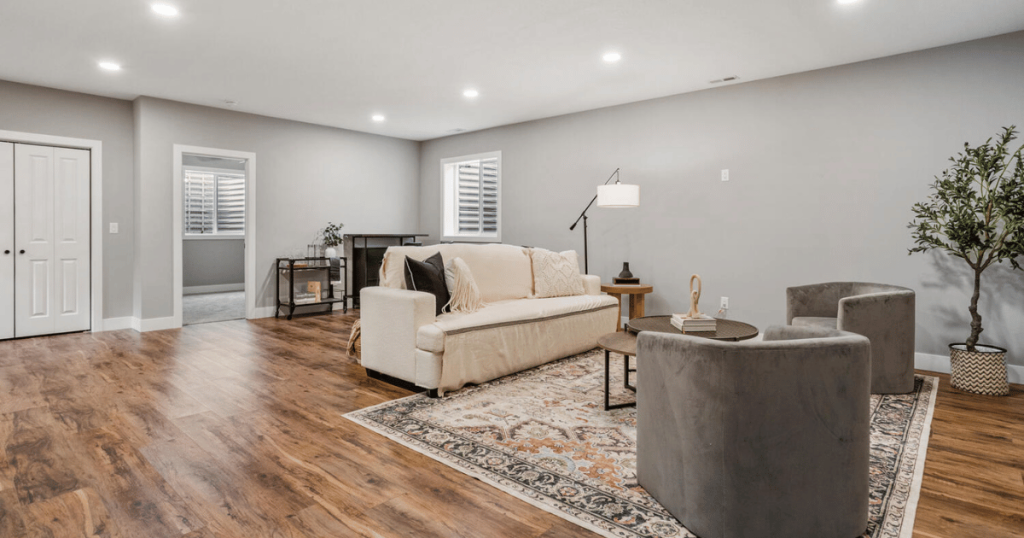
Most basement finishing projects take 4 to 8 weeks from the start of construction, but that number only tells part of the story. Add in planning and permitting, and you’re realistically looking at 8 to 14 weeks total before you’re enjoying the finished space. The exact timeline depends on the size of your basement, what features you’re adding, and how well the project is coordinated from the start.
This guide walks through each phase so you know what to expect and where delays actually happen.
Quick Reference: Basement Finishing Timelines by Scope
Before getting into the phases, here’s a straightforward baseline based on project scope:
- Basic finishing (open layout, no bathroom): 4 to 6 weeks of construction
- Mid-range with a bathroom: 6 to 9 weeks of construction
- Full buildout (bathroom, wet bar, multiple rooms, custom features): 9 to 12+ weeks of construction
Add 2 to 6 weeks for planning and permitting on top of those numbers. That’s your real start-to-finish window.
Phase 1: Design and Planning — 1 to 2 Weeks
The design and planning phase typically takes 1 to 2 weeks and lays the groundwork for everything that follows. This is where you finalize scope, layout, and material selections before a single wall goes up.
What happens during this phase:
- Initial consultation and scope review
- Layout planning (rooms, walls, ceiling height, egress)
- Material selections (flooring, fixtures, lighting, finishes)
- Budget confirmation and project estimate
The decisions you make here affect every phase that follows. Changing your mind about a bathroom location after framing starts costs time and money. Backordered flooring discovered during installation costs time, too. Locking in selections before construction begins is one of the most practical ways to keep your project on schedule.
At C-U Under Construction, we walk through selections at our showroom so you can see materials in person before committing. That step alone tends to significantly reduce mid-project changes.
Phase 2: Permits — 1 to 3 Weeks (Sometimes Longer)
Permits for basement finishing are required in most Illinois municipalities, and this phase is the one that homeowners underestimate the most. In Champaign and surrounding communities, you need permits for any project that involves framing new walls, electrical work, plumbing, or HVAC. That covers nearly every basement finishing project.
What affects permit timing:
- Plan review workload at the local building department
- Scope complexity (a basic open basement reviews faster than one with a bathroom and bedroom)
- Revisions required on submitted plans
Residential permits in Champaign are typically calculated at approximately 0.5% of the estimated project cost, plus a plan review fee. The approval process itself generally runs 1 to 3 weeks for straightforward projects. Projects requiring separate electrical or plumbing permits may need additional review time.
One thing worth knowing: electrical, plumbing, and framing each require their own inspections before work can proceed to the next phase. A contractor who knows how to sequence and schedule those inspections efficiently keeps your project moving. One who doesn’t can add weeks of dead time waiting for inspectors to return.
Phase 3: Framing — 3 to 5 Days
Framing typically takes 3 to 5 days for an average-sized basement. This is when walls, soffits, and door openings take shape, and the layout you planned on paper becomes a physical space.
What affects framing time:
- Number of rooms and partition walls
- Existing obstructions (support columns, ductwork, plumbing stacks)
- Whether an egress window opening needs to be framed
If your basement has a lot of mechanicals to work around, a furnace, a water heater, and a main stack, that adds complexity. A good framing plan accounts for those from the start rather than figuring them out on-site.
Phase 4: Rough-In Trades (Electrical, Plumbing, HVAC) — 1 to 2 Weeks
Rough-in trades typically take 1 to 2 weeks to complete and must be inspected before drywall goes up. This phase includes running all wiring, plumbing supply and drain lines, and any HVAC ductwork or zone additions through the open wall cavities.
This is the phase that most commonly causes delays, not because the work is slow, but because of scheduling gaps between trades. When a general contractor relies on multiple subcontractors, you’re coordinating three or more separate schedules and waiting for each trade to wrap before the next one can start. Inspections between each rough-in can extend this further if scheduling is loose.
At C-U Under Construction, our HVAC, plumbing, and electrical work is handled through C-U Trade Services, our in-house trades division. That means we’re not waiting on outside subcontractors to open up their schedule. The trades move in sequence, inspections get scheduled proactively, and the project stays on track.
If your basement includes a bathroom, a wet bar, or additional HVAC zones, budget toward the longer end of this window.
Phase 5: Insulation and Drywall — 5 to 10 Days
Insulation and drywall together typically take 5 to 10 days. Insulation goes in first; the Illinois code requires a minimum of R-13 on exterior basement walls. Then, the drywall is hung, taped, mudded, and sanded.
The reason this phase takes longer than people expect is the drying time between coats of drywall. You can’t rush it. Each coat of joint compound needs to dry fully before the next one goes on. Trying to shortcut this step shows up in the finish, uneven surfaces, visible seams, and paint that doesn’t lay flat.
Basements also present a moisture consideration that above-grade spaces don’t. Proper installation of vapor barriers and insulation protects against long-term moisture issues. It’s not glamorous work, but it matters for the durability of everything that goes on top of it.
Phase 6: Flooring, Paint, Trim, and Finishes — 1 to 2 Weeks
Flooring, paint, and trim work typically take 1 to 2 weeks and are the phase where the space starts to look like what you actually planned. Paint goes first, then trim and doors, then flooring.
Approximate time by task:
- Paint: 2 to 4 days (including prep and drying between coats)
- Trim and doors: 2 to 5 days, depending on the number of rooms
- Flooring: 2 to 5 days, depending on material (carpet installs faster; tile requires additional curing time)
- Fixtures and lighting: 1 to 3 days
Material lead times can affect this phase. If your flooring or fixtures are backordered, that’s where the project sits. Ordering materials early, during the permit or framing phase, is one of the simplest ways to prevent a gap here.
Phase 7: Final Inspection and Walkthrough — 2 to 5 Days
The final inspection and project walkthrough typically take 2 to 5 days. The building inspector visits to confirm that all work meets code, that the permit is closed out, and that any remaining punch list items are addressed before the project is considered complete.
What happens during this phase:
- Final building inspection scheduled with the city
- Electrical and plumbing close-out inspections (if applicable)
- Contractor punch list review
- Client walkthrough and sign-off
At C-U Under Construction, every finished basement project comes with our 1-year workmanship warranty. If something isn’t right after you move in, we come back and take care of it.
What Actually Slows Basement Projects Down
The construction phases rarely cause delays on their own. Here’s what does.
Permits move on their own timeline. A backlogged building department can push your start date by 2 to 4 weeks. Submitting clean, complete plans the first time is the only lever you have; revision cycles add time you can’t get back.
Unfinished basements hide problems. Water intrusion, foundation cracks, and outdated wiring none of them show up until walls come down or framing starts. These aren’t optional fixes. The project doesn’t move forward until they’re addressed.
Trades that can’t coordinate cost you weeks. When a GC is juggling three separate subcontractor schedules, gaps happen. One trade finishes, the next one isn’t available for five days, and inspections get pushed. It compounds faster than most homeowners expect.
Materials ordered late sit and wait. Specialty tile, certain flooring products, and custom fixtures can take 3 to 6 weeks to arrive. If those orders go in after framing rather than during permits, the project stalls at the finish line.
Changes mid-project are expensive in two ways. They cost more than if you’d planned them, and they cost time. Moving a wall after framing or adding a bathroom after the rough-in requires rework on work that was already completed.
How to Keep Your Project on Schedule
There are things within your control that make a real difference.
Finalize your scope before work starts. Know what rooms you want, whether you need a bathroom, and what features matter most. Contractors can price and schedule accurately when the scope is locked.
Make material selections early. Don’t wait until drywall is done to pick your flooring. Your contractor should order materials during earlier phases so they’re ready when needed. (Check out our selection guide)
Understand the permit process in your municipality. If you’re in Champaign, Urbana, Savoy, or surrounding areas, ask your contractor about typical permit timelines in your jurisdiction. Plan around them, not around a best-case scenario.
Work with a contractor who manages trades in-house. The biggest scheduling risks in basement finishing come from coordinating multiple outside subcontractors. A contractor with in-house electrical, plumbing, and HVAC can sequence that work more efficiently. (P.S., we have in-house trades).
Frequently Asked Questions
How long does it take to finish a basement with a bathroom?
A basement with a full bathroom typically takes 6 to 10 weeks of construction, plus 2 to 4 weeks for planning and permits. The bathroom rough-in adds time for plumbing and a separate inspection before walls can close.
A basement with a full bathroom typically takes 6 to 10 weeks of construction, plus 2 to 4 weeks for planning and permits. The bathroom rough-in adds time for plumbing and a separate inspection before walls can close.
Do I need a permit to finish my basement in Illinois?
Yes. In Illinois, permits are required for basement finishing projects that involve framing new walls, electrical work, plumbing, or HVAC. This includes most finishing projects. Requirements vary slightly by municipality, so check with your local building department or ask your contractor.
Yes. In Illinois, permits are required for basement finishing projects that involve framing new walls, electrical work, plumbing, or HVAC. This includes most finishing projects. Requirements vary slightly by municipality, so check with your local building department or ask your contractor.
What’s the difference between finishing and remodeling a basement?
Finishing a basement means converting unfinished space into livable square footage for the first time by framing, insulating, drywalling, flooring, and installing utilities. Remodeling typically refers to updating or reconfiguring a finished basement. Finishing usually takes longer because more systems are being installed from scratch.
Finishing a basement means converting unfinished space into livable square footage for the first time by framing, insulating, drywalling, flooring, and installing utilities. Remodeling typically refers to updating or reconfiguring a finished basement. Finishing usually takes longer because more systems are being installed from scratch.
Can I live in my home while my basement is being finished?
Yes. Basement finishing projects don’t typically displace the rest of the home. Expect dust, noise, and occasional utility shutoffs for trade work, but you’ll be able to use the main living areas throughout the project.
Yes. Basement finishing projects don’t typically displace the rest of the home. Expect dust, noise, and occasional utility shutoffs for trade work, but you’ll be able to use the main living areas throughout the project.
How much does it cost to finish a basement in Champaign, IL?
Basement finishing costs in Champaign typically range from $25 to $60 per square foot, depending on scope, materials, and features. A 1,000-square-foot basement with standard finishes and a bathroom generally runs between $35,000 and $55,000. Adding custom features, a wet bar, or high-end materials will push that higher.
Basement finishing costs in Champaign typically range from $25 to $60 per square foot, depending on scope, materials, and features. A 1,000-square-foot basement with standard finishes and a bathroom generally runs between $35,000 and $55,000. Adding custom features, a wet bar, or high-end materials will push that higher.
Ready to Get Started?
If you’re planning a basement finish in Champaign-Urbana or the surrounding area, the best first step is a conversation about scope. We’ll walk through what you envision, provide a realistic timeline for your specific project, and explain the process before any commitments are made.
Contact us today to get the conversation started!